Some expressions end up replacing the facts. “Three centuries of Turkish colonisation” is one of them.
The phrase circulates through a curious convergence of voices: those nostalgic for French Algeria, far-right polemicists and Moroccan royalist networks. In September 2021, it even reached the Élysée Palace. Emmanuel Macron then questioned whether an Algerian nation had existed before 1830, referred to “previous colonisations” and said he was “fascinated” that Turkey had managed to make people forget its former domination of Algeria.
What is rather fascinating is how colonial representations persist in public debate despite the work of historians on both sides of the Mediterranean.
Yet one need only return to the beginning of this history.
1516: ALGIERS CALLS FOR HELP
The Algerian historian Nacereddine Saïdouni, a specialist in this period, emphasises an essential fact: the Barbarossa brothers did not land in Algiers at the head of an Ottoman army intent on conquering the country.
In the early sixteenth century, it was the Iberian powers that were advancing along the Maghreb’s coasts. Oran, Mers el-Kébir and Béjaïa fell or came under Spanish control; off Algiers, the Peñon enabled the Spanish to keep the city under threat from their cannon.
It was in this context that the people of Algiers sought Arudj Barbarossa’s help in 1516. James McDougall recalls this in his History of Algeria: Arudj was called upon by the inhabitants of Algiers to assist them. In 1519, after his death, an army combining local fighters, Andalusians and Turks repelled a Spanish expedition of about 5,000 men. That same year, leading inhabitants of Algiers sent Sultan Selim I a letter on behalf of the city’s population.
The ambitions of the Barbarossa brothers, their methods and the violent struggles for power can be debated. They were very real. But the initial fact cannot be erased:
In 1516, Algiers called for help; in 1830, Algiers was invaded.
CHOOSING THE GREAT MUSLIM POWER
Saïdouni highlights a second factor: religion.
Viewing 1519 through the categories of the modern nation-state makes little sense. Habsburg Spain had recently completed the Reconquista and was advancing into North Africa. Facing it, the Ottoman Empire had become the Mediterranean’s principal Muslim military power.
Selim I had just conquered Syria and Egypt. The Ottomans increasingly asserted themselves as protectors of the Sunni Muslim world and gradually claimed caliphal legitimacy.
The familiar account of an “official transfer” of the caliphate to the sultan in 1517 is debated by historians. But that does not change the political reality of the period: for Algiers, placing itself under the Ottoman ruler’s protection meant joining the Muslim world’s principal centre of power against Spanish expansion.
And Algiers was clearly no exception: Egypt, Syria, the Hejaz, Tripolitania and Tunisia belonged, in various forms, to the same imperial whole.
Why, then, treat this connection specifically as proof of historical non-existence when Algeria is concerned?
WHEN THE “REGENCY” ELECTS ITS LEADER
There is something more awkward still for the thesis of a colony administered from Istanbul for three centuries.
In the seventeenth century, Algiers gradually freed itself from the Sublime Porte.
The rule of the deys emerged in 1671. After 1689, the dey was chosen in Algiers by the Divan. In 1710, he secured the absorption of the pasha’s office into his own. Algiers formally remained within the Ottoman Empire, but the Porte exercised only very limited influence there.
Algiers collected its own taxes and conducted its own foreign policy: in 1795, the dey and the Divan directly concluded a treaty of peace and friendship with the United States. This autonomy acquired within the Ottoman Empire contrasts with the French conquest, which overthrew the government of Algiers in 1830.
The established term “Regency of Algiers” therefore deserves, at the very least, to be questioned when it suggests a mere Turkish governorship.
Contemporaries also spoke of the “State of Algiers”, the “Kingdom of Algiers” and even the “Republic of Algiers”.
“Republic” obviously does not mean a modern democracy: the system remained military and oligarchic. But it describes a reality that the word “Regency” sometimes obscures: the leader was not a hereditary monarch and was no longer chosen in Constantinople.
A strange colony indeed, electing its leader, collecting its own taxes and signing its own treaties.

1830: THE GREAT REPLACEMENT
The contrast is stark.
On Jun 14, 1830, Charles X landed around 37,000 French soldiers at Sidi-Fredj. He was answering no Algerian request. He had sent a military expedition to defeat the government of Algiers.
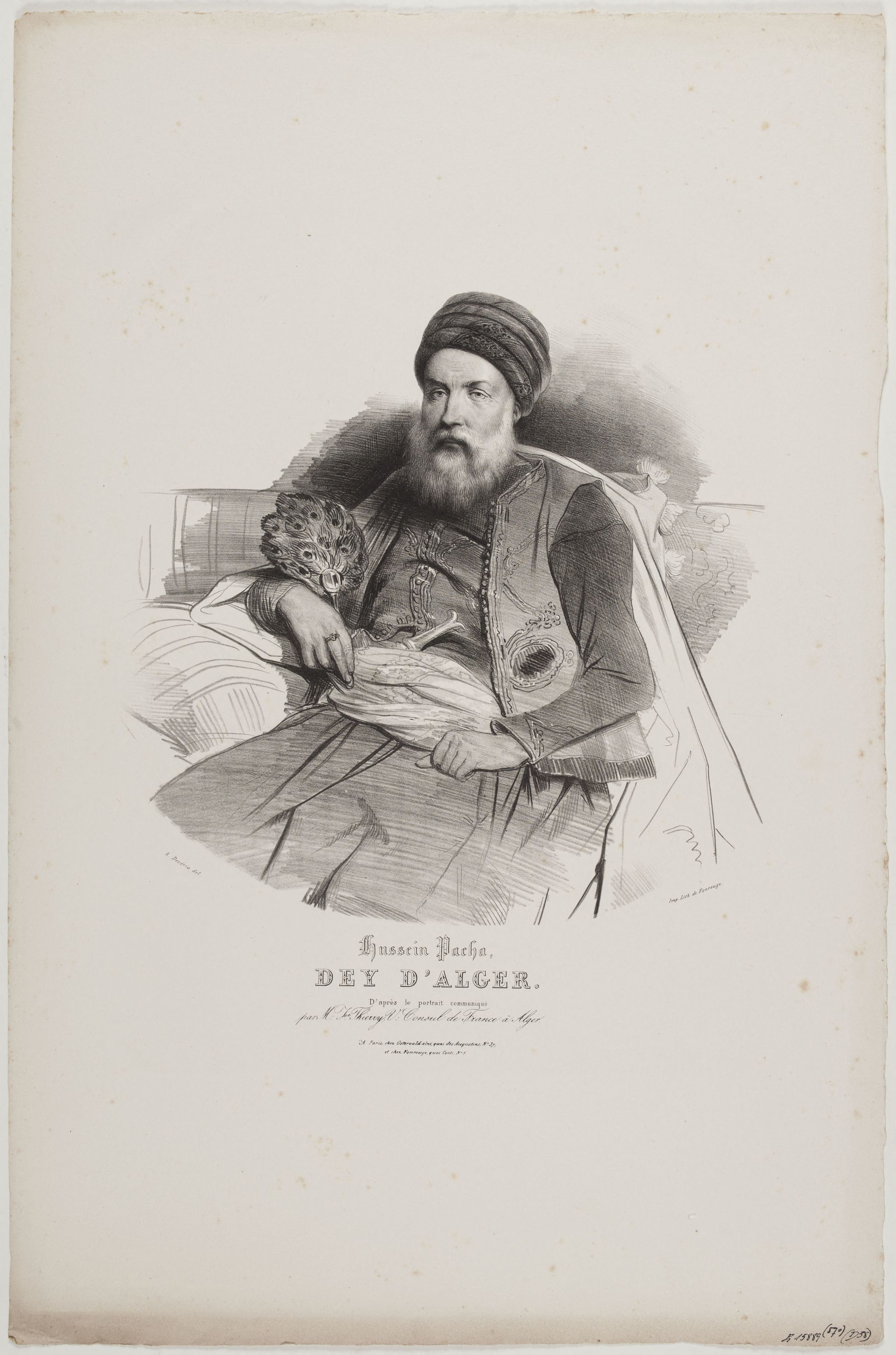
On Jul 5, 1830, Hussein Dey capitulated.
The conquest then spread. This was the “first Algerian war”, from 1830 to 1871, to use the phrase adopted in the documentary co-written by Benjamin Stora. Forty years of massacres, killings by smoke asphyxiation, raids, burned villages, destroyed crops and displaced populations.
And behind the soldier came the settler.
According to the higher estimates, Algeria had nearly five million inhabitants in 1830. By 1871, the recorded population was only around 2.1 million. The imprecision of contemporary statistics prevents a definitive accounting. It does not erase the scale of the demographic catastrophe.
Abdelmadjid Tebboune speaks of a “real great replacement”, carried out by a “genocidal army”: driving out or decimating the Algerian population to settle Europeans in its place. The genocide of conquest was followed by colonial ethnocide: the systematic erasure of the Algerian people’s institutions, social structures, language, culture and memory.
This is a fundamental difference. The Ottoman Empire never organised mass migration into Algeria intended to take over the land. France, by contrast, built a genuine settler colony. An attempt at a great replacement. In 1954, nearly a million Europeans lived in Algeria.
The rupture also affected education. Under the Regency, schools, madrasas and zawiyas had their own resources. The conquest disrupted this network and seized assets that had financed it, as Kamel Kateb recalls. Tocqueville himself observed the devastation this policy inflicted on education. Here again, the comparison concerns what the conquest destroyed and transformed.
MEANWHILE, IN MOROCCO…
A detour through Morocco makes the use of these terms more interesting still.
At the very time Algiers was turning to the Ottomans to resist Iberian expansion, Portugal was directly occupying Moroccan cities. Ceuta was conquered in 1415, Ksar es-Seghir in 1458 and Asilah in 1471; Tangier subsequently came under Portuguese control.
After the capture of Asilah, the Wattasid ruler Mohammed al-Cheikh concluded a treaty with the king of Portugal recognising several Portuguese possessions.
Further south, documents reveal even more explicit relationships: local leaders accepted the Portuguese king’s protection, paid him tribute or were described in Portuguese sources as subjects or vassals. In 1516, Manuel I thus invested Yahya ben Ta‘fuft with authority in Safi and Doukkala.
When Algerians called on a Muslim power to fight Spanish occupation, five centuries later this is reclassified as “Turkish colonisation”.
When Moroccan territories were actually conquered by Portugal and some of their leaders accepted protection, tribute or vassalage, the vocabulary suddenly becomes much more cautious.
THE COLONISER AND OTHER PEOPLE’S HISTORY
One question therefore remains: why this obsession with proving that Algeria had been colonised even before the French arrived?
The historian M’hamed Oualdi has recalled how old this representation is: Algeria supposedly always endured the rule of others — Arabs, then Turks, then the French — as though its society had never produced its own history.
The coloniser has an unfortunate tendency to begin by denying the history of those being colonised. It needs a territory without a state, a society without political depth, a people eternally subjected to foreigners.
We recognise the argument: a land without a people for a people without a land…