Fifty-three years. That is how long it has taken for Algerian soldiers to serve beyond our borders again.
Parliament’s vote on Sunday 25 October was historic and received almost unanimous approval. But history will not remember the day the People’s National Army (ANP) left. It will remember what Algeria built thanks to it.
This deployment is not an end in itself. It creates an opportunity.
The Trans-Saharan Gas Pipeline: 4,128 kilometres that will put ambitions to the test
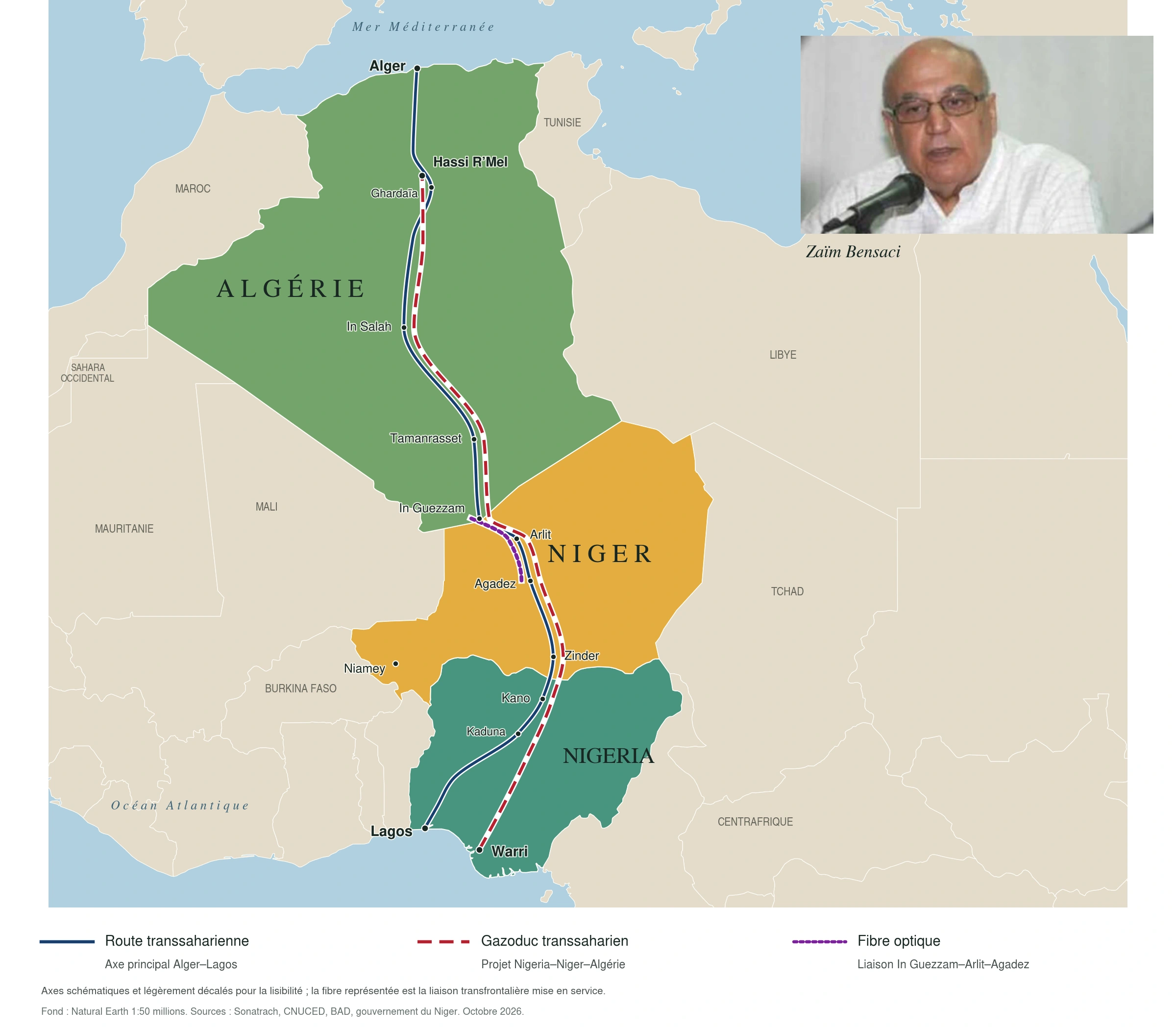
The Trans-Saharan Gas Pipeline connects Warri, in Nigeria, to Hassi R’Mel. It is 4,128 kilometres long, including 841 across Niger. It is intended to carry 20 billion cubic metres a year initially, rising to 30 billion.
On the Algerian side, machinery has been at work since June in Aoulef. On the Nigerien side, topographical surveys are still under way. Algeria is digging; Niger is surveying. The challenge lies in closing that gap.
Everything depends on this Nigerien section. Without it, the continent’s largest energy project remains an attractive map on a ministry wall. With it, Algeria becomes the gas link between West Africa and Europe.
Security, the Sahel’s most valuable asset
A banker will not lend without a clear view of the risks. An investor will not sign where no one offers any guarantees. In the Sahel, the foremost asset is neither gas nor oil: it is security.
That is precisely what Algeria provides by protecting Sonatrach’s facilities, at Niamey’s request and under a duly concluded agreement. The message to lenders, partners and competitors is clear: this corridor now has a guarantor.
And there is competition. Another route, along the Atlantic, has been proposed to Nigeria. In this race, a lead is not established by announcements: it is built on the ground, kilometre by kilometre.
The trap to avoid
The Sahel has already seen armies arrive to protect mines and wells without changing residents’ lives. We know what followed: mistrust, then rejection, then departure.
Algeria must not repeat that scenario. It has an advantage no one can dispute: it is a neighbour, not a distant power. A shared border, a shared history, families on both sides. That advantage will endure only if it quickly delivers visible results.
Three priorities, starting now
Jobs first. Every well drilled in Kafra and every kilometre of pipeline laid in Niger must generate wages, training and contracts for Nigerien companies. Infrastructure that benefits local people is infrastructure they will protect themselves.
Then roads. The Trans-Saharan Highway, rail and fibre optics are not secondary projects. They are what turns a pipeline into a market. Gas passes through Niger without stopping; lorries stop, unload and sustain towns.
Finally, our small and medium-sized enterprises (SMEs): this is where everything will be decided. Having chaired the National Consultative Council for the Promotion of SMEs, I know both their potential and the obstacles they face. Sonatrach opens the way, but a large group alone cannot establish a lasting economic presence. SMEs sustain a territory: construction and public works, maintenance, logistics, agrifood and services.
They must be given the means to go there. An SME cannot venture into Agadez or Niamey alone. It needs export credit insurance suited to the Sahel, banks that will support it across the border, and the ability to form consortia to bid for contracts. SMEs must also be given priority in subcontracting for major Algerian projects in Niger. With its skills, capital and networks, the diaspora can provide a natural bridge. It is waiting for a signal.
After the soldiers, the builders
The ANP has opened the door. It remains to be seen who will walk through it. If only soldiers do, this deployment will remain just another security episode in the Sahel’s history. If engineers, entrepreneurs and investors follow, it will mark the beginning of an Algerian era in Africa.
The first battle, over the decision, has been won. The second, over the economy, begins now.
Loading…